Dr Amandeep Gujral | Spine Care India
Discover expert healthcare solutions designed to support better care, visibility, and growth.
Read patient stories, explore our gallery, and stay updated with the latest blogs.
When an MRI or other scan shows an unusual area in the spine, a biopsy may be recommended to understand exactly what is causing it. A spine biopsy can help identify infection, inflammation or a tumor and guide the next step in treatment.
Suspected tumors, infections and unusual spinal lesions
Identify the exact cause
Usually a targeted minimally invasive procedure
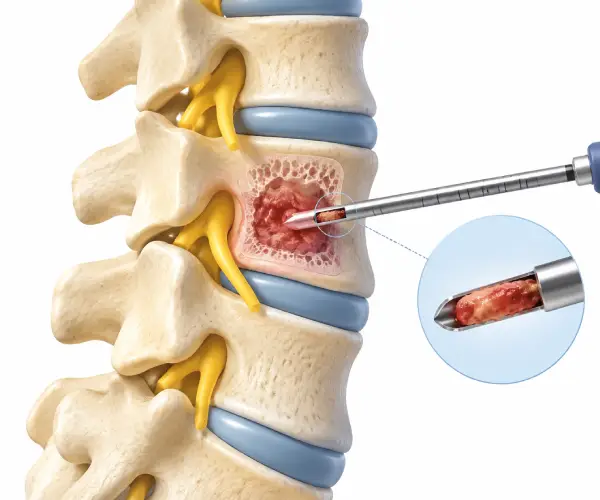
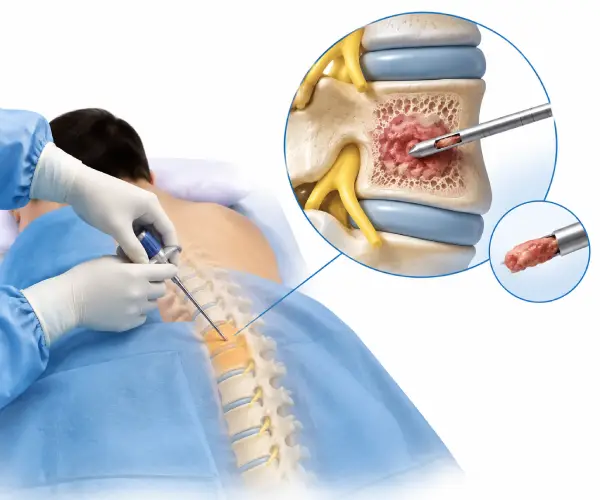
A spine biopsy is a procedure in which a small tissue sample is taken from an abnormal area of the spine.
The sample is examined in a laboratory to understand what is causing the abnormality.
MRI, CT or another scan may identify an area that needs further evaluation.
Different conditions can sometimes look similar on scans.
A biopsy allows the laboratory to examine the actual tissue and help identify the diagnosis.
A biopsy may be considered when there is:
A biopsy is not required for every spine problem.
A spine biopsy may help identify:
Such as tuberculosis or bacterial infection.
It can help determine whether a lesion is benign or malignant and identify its type.
In selected cases, tissue examination may help identify inflammatory conditions.
The biopsy is planned according to the location and nature of the abnormal area.
A biopsy itself is not usually the final treatment. Its purpose is to provide information that helps doctors decide the next step.
The treatment after biopsy may involve:
Imaging is used to locate the abnormal area accurately.
The area is numbed before the procedure.
A specialized needle is guided to the target area.
A pathology laboratory examines the tissue and provides a report.
You may be observed for a short period after the procedure.
Some soreness around the biopsy area may occur.
The laboratory report helps the treating doctor understand the condition and plan treatment.
Your doctor will explain the results and discuss the next steps.
When imaging shows an unusual spinal lesion, knowing the exact cause is important.
A clearer picture of what a slip disc is, how microdiscectomy works, and what recovery actually looks like.
No. It is recommended only when the scan and clinical information indicate that tissue diagnosis is needed.
The area is usually numbed with local anesthesia. Some soreness may occur afterwards.
An MRI can show where an abnormality is located, but a biopsy can sometimes be needed to identify exactly what it is.
A biopsy can help identify and classify a tumor, including whether it is malignant.
Recovery varies depending on the biopsy location and individual health. Your doctor will provide specific instructions.
Do not panic. A proper diagnosis is the first step toward understanding the condition and choosing the right treatment.